Rondam Ramblings
Adam: Hello and welcome to CoRecursive. I’m Adam Gordon Bell. Years ago, I found this blog called Rondam Ramblings. This author Ron Garrett had written about his time working at Google in the very early days. Turns out Ron Garrett was also this guy named Erann Gat, who was most well known for this essay he published in 2002 called Lisping at the JPL.
If you spent a lot of time on Hacker News, you probably saw this. It was sort of a timeline of how Lisp was used and then not used at NASA’s Jet Propulsion Laboratory.
I reached out to Ron, and we had an interview and it was great, and that became the episode Lisp in Space. It is one of my favorites. It’s such a crazy story. You have like a, a Lisp REPL connecting to like a, a literal spaceship, you know, a long, long ways from the earth.
Debugging issues. It’s literally science fictional stuff. But yeah, also part of the story is him and his little research group were sort of working against the grain of NASA, the grain of NASA being, you know, NASA’s preference for certain ways of doing things.
And so slowly this Lisp usage faded. People left the group that he was part of, and you know, NASA is not using a lot of Lisp today, I am guessing.
But here’s the thing. The original idea when I reached out to talk to Ron was to talk about early Google, what it was like there in those days, and we did record that and I released it as a bonus episode for Patreon supporters. But I thought today, you know, for me it’s, it’s January 2nd, 2026, currently in Mexico, enjoying some much needed time off, but I’ve scheduled this ahead of time.
I thought it would be good to give you guys a taste of the Patreon episodes I made, so never heard before outside of the CoRecursive supporters. Here is bonus episode number seven, creating Google AdWords.
So if you haven’t listened to episode 76, please do. But I mean, you can listen to it after. These things are freestanding.
When we left Ron in that episode, you know, his autonomous flight software written in Lisp had made it into deep space and encounter problems, and he’d been able to debug them. But overall, you know, NASA didn’t consider the mission a success and Ron was just a bit frustrated with things.
And around this time of his peak frustration, he discovered something new.
Fifteen Minutes Later, the Phone Rang
Ron: I was reading a Usenet newsgroup, in fact, comp.lang.*. And somebody answered some obscure technical question, which I don’t remember what the question was anymore, but they gave this answer and then followed up saying, thank God for Google. And I was like, what the heck is Google?
And so I did what one did in those days when one encountered something that was unfamiliar, was pull up my Netscape Navigator and type in www.google.com. And sure enough, it was a search engine kind of like AltaVista, except that after just five minutes of noodling around with it, it was obvious to me that this was light years ahead of anything else that existed at the time.
And it was so good and so fast that my jaw was just on the floor saying, how the heck do they do that? And at the bottom of the page, there was this link saying we’re hiring.
So in a fit of what Alan Greenspan would call irrational exuberance, I dashed off a resume and 15 minutes later, my phone rang.
Adam: So this is the year 2000. Google was brand new and pretty small, less than a hundred employees, and one year earlier it had secured, uh, $25 million in funding from Kleiner Perkins and had moved to Mountain View.
It was a scrappy startup and the job paid less than his current salary. But Ron was hearing so much about the dot-com boom, and he wanted to be involved.
Ron: My job was secure and I could more or less do what I wanted. And we had just bought this new house that was like a mile away. So not only did I have this great job, but I had a really cushy commute, which in LA that’s like the ultimate luxury. And so I didn’t really want to give that up.
And so after weeks of agonizing, I initially turned them down, but they wouldn’t take no for an answer. They leaned on me hard and sweetened the deal and gave me a travel allowance and said, oh, just try it for a year. And if it doesn’t work out, then you can go back. And that is what ultimately convinced me.
Adam: This was also at the height of Ron feeling like he just didn’t fit in at the JPL. He was the Lisp guy in the C world.
Ron: When I announced that I was leaving, it’s not like I gave the middle finger and said, fuck you and your little dog too. I just announced, I’ve gotten this offer and I’m going to take it. Which is when all of these people suddenly said, no, we don’t want you to go. And this division managers said, I really don’t want you to go. And I want you to promise that you’ll come back.
You know, these promises are worth the paper they’re printed on, but I wasn’t really expecting the Google would work out. I was kind of expecting it would be a temporary thing because I didn’t even initially, I didn’t really see how it could work out because of the commute.
So I would get up at four in the morning and leave the house at five and get to the airport by six to catch a six 30 or seven o’clock Southwest flight from Burbank to San Jose, where I had, over the course of the year, I had various means of getting from the airport to Google, including rideshares and taxis. And I eventually kept a car up there.
And so I’d get to the office about 10 and start working and work into the night because I didn’t have a life up there. And then I’d worked Tuesday, Wednesday, and then Thursday through early to mid afternoon, when I would head back to the airport to catch a flight home.
Adam: So was that exhausting or exciting?
Ron: It was kind of cool at first, but it got, yeah, exhausting, stressful. We’d just gotten this house. We’d just gotten this dog and this cat and my wife was unhappy too, because she was taking care of the house and taking care of the pets while I was off gallivanting and living this glamorous startup life. So yeah, it was just stressful all around.
And then on top of that, the work situation was very stressful because a mistake that I made was not achieving clarity on what it is that they were hiring me to do. I just figured that I’d get there and they would put me to work on something cool.
They Hired the Wrong Person for This Job
And what they put me to work on was AdWords. And then to make matters worse, one of the reasons that I had passed up on a lot of other opportunities to go work at dot-com startups, and why I took the job at Google, is because at the time Java was the hot thing and everybody was coding in Java.
And I despised Java with a deep and abiding passion, which I still do, because it was designed by really smart people, including Guy Steele, who is one of the designers of Common Lisp, people who really should have known how to design a proper good language, and they didn’t, they designed a piece of shit.
I’m being too harsh on it. It’s not a piece of shit. It was designed to be something to be part of a process that I didn’t want to be part of. It was designed to be part of a process where you could hire programmers that could be interchangeable parts as part of an industrial process.
Adam: So you’re like, if you write Java, you’re a cog in the wheel?
Ron: Yeah, it was designed to turn programmers into cogs and wheels, cogs and machines. And in that respect, it’s succeeded spectacularly well, but I really didn’t want to be that kind of a cog. Like the amount of boilerplate that you have to write in order to write a Java program just drove me bananas.
And so I get to Google, who’s not using Java, and that’s one of the reasons I’m there. And Urs Hölzle, the VP of engineering, comes to me and says, here’s what we want you to do. We’re not going to put you to work on the search engine, which is the cool stuff. We want you to write this ad system and we want you to do it in Java.
We want you to be the Java evangelist at Google and the person who instigates the introduction of Java into Google, and boy, did they hire the wrong person to do that job.
But, you know, at that point I didn’t really feel like I had a whole lot of choice. And so I did it. Unfortunately they assigned a guy to work for me who actually knew what he was doing, a guy named Jeremy Chow, and Jeremy actually wrote the lion’s share of the actual code.
Adam: Ron is a talented computer scientist. You know, he many times has created his own programming language and then his own compiler for it, written of course in Lisp, and then compiled down to real-time sensor processing, real-time code on a microcontroller.
Not to mention doing complicated things like proving invariants about his code that it couldn’t deadlock or couldn’t get into certain bad states. That was his preferred approach to things, and he could have brought a custom DSL to AdWords.
Ron: So, that would have been the wrong thing to do because AdWords is, you know, AdWords makes a ton of money. But it’s just a web app. You know, it’s just a UI for customers to enter information that ends up in a database that then gets fed to the ad server, which then serves ads and writes data into a database, which then gets read by the billing system, which I actually did write, which charges people’s credit cards.
So none of this is rocket science, but they hired a rocket scientist, or at least.
Adam: Yeah.
Ron: Yeah. I was not really a rocket scientist. I actually worked with some real rocket scientists, but I was not a rocket scientist, but I was a researcher. So they hired a researcher to write a production system who had never written a production system before.
I mean, I’d done some noodling around with the worldwide web, but it was just that. It was all noodling because my entire career basically was noodling. My job was to noodle around with something until I kind of sorta got it to work and then hand it off to somebody else and write a paper about it.
And now suddenly I had the job to actually write a production system for the first time ever in my life with no training and no guidance. They just threw me into the deep end and said, here, go do it because Google has this attitude that smart people will figure it out.
And I might’ve figured it out, if not for the fact that I had on top of being thrown into the deep end, they gave me a three month timeline. So they gave me a deadline. So I had three months to figure this out. And so I had to balance climbing the learning curve with actually getting things done.
And that is a catastrophic mistake. Something I would really very strongly advise any manager supervising somebody that they’re either figuring out how to do it or they’re doing it, but trying to do both at the same time, that does not work.
The Most Stressful Year of His Life
Adam: So Ron was flying in and out each week. He’s working late, uh, and he was staying in Mountain View, renting a room at Susan Wojcicki’s house, which was actually where, you know, the garage where Google’s first office was, and it seemed like a fascinating life at first, but the shine quickly wore off.
Ron: That year was the most stressful year of my life.
Adam: How come?
Ron: Well, because I’d taken this big risk and I was far from home and I was screwing up left and right. And the future of my career was in doubt. And I wasn’t getting a lot of sleep. What more do you want?
Adam: Yeah, I mean, I don’t mean to poke at a scab. It’s just interesting, like, I mean, you’re very, I mean, clearly, a very smart and talented person. Like what, like what do you mean by screwing up?
Ron: I did not feel technically adequate to the task that had been assigned. So, I was struggling to climb all these learning curves while at the same time trying to build a production system for the first time. And while I was doing all this, I was also trying to deal with the psychological stress of being forced to use what felt to me like the wrong tools for the job.
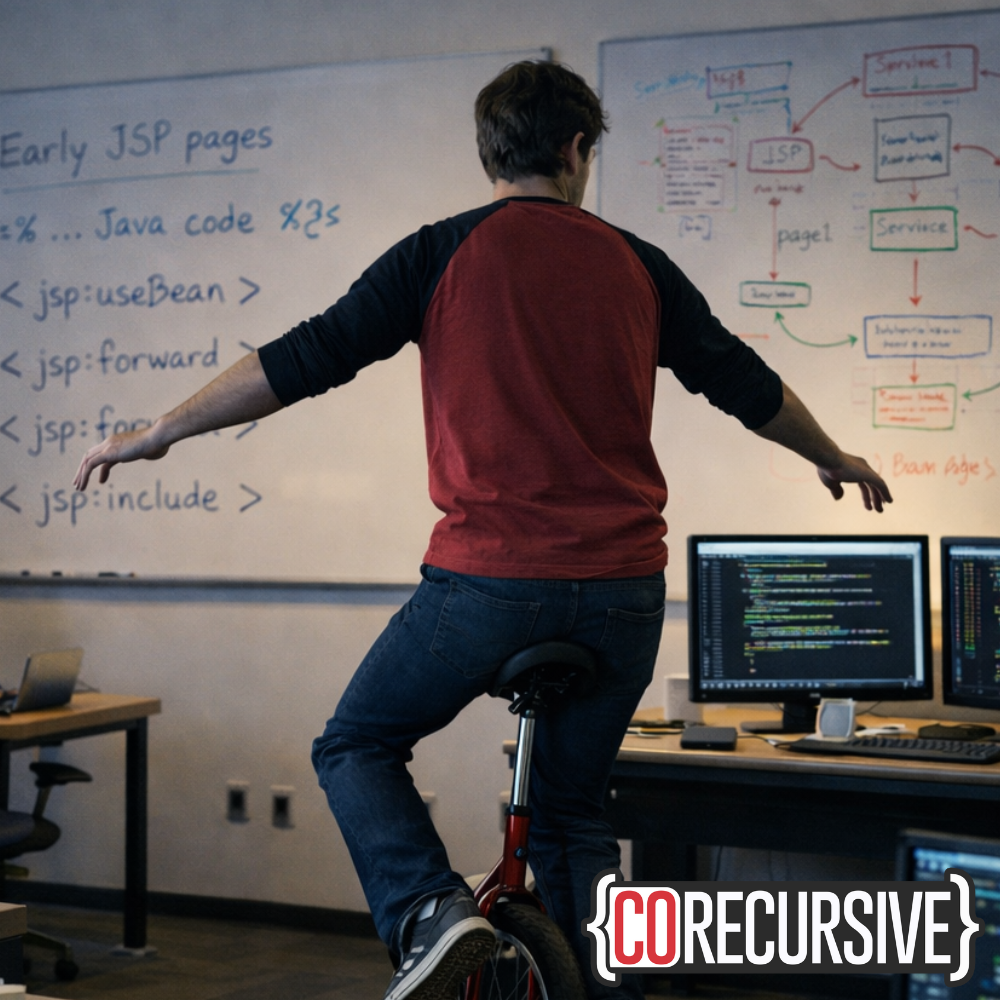
And so I had to do all this stuff while setting aside my personal frustration with how crappy Java was, and it wasn’t just Java. It wasn’t just we were just using Java. We were actually using JSP (JavaServer Pages).
Have you ever—
Adam: I have, a long time ago. Yeah. So it’s kind of like a PHP, it’s like—
Ron: It’s very much like PHP except with embedded Java inside HTML.
And one of the things that we lacked was a syntax aware editor. So we were editing and debugging JSP code without any syntax highlighting, without any delimiter balancing. We’re doing it all manually. And JSP pages are just a freaking nightmare trying to—
Because the errors that you get when you get an error in a JSP page, it’s pages and pages of error messages. They’re just nightmarish and very often the error itself is produced in a part of the page that’s very far from the place where the actual mistake is, because like you’ll have a typo in a delimiter.
And so the code will get interpreted wrong. It’ll, a piece that’s Java will end up being interpreted as if it was HTML or vice versa, except that it doesn’t really manifest itself until it’s parsed another couple of dozen lines. And so the error will get produced at this point in the file, but the actual typo is in a completely different place in the file.
It’s like trying to find a needle in a haystack because your editor isn’t helping you at all. So you’re reading through this code, trying to parse it yourself and there’s no auto indentation. It’s, it was just a nightmare.
Two New Hires Behind a Closed Door
Ron: In fact, at one point I offered to resign. But they said that I wasn’t screwing up as badly as I thought I was, that I should stay. So I did.
Adam: I mean, any chance you were just perceiving it wrong and they were just like, this is how he’ll learn Java, we’ll throw him in?
Ron: Yeah, I don’t know. I was never well integrated into the Google culture. So another thing that Google did wrong was because I was very senior on paper, you know, I had a PhD and all this experience, I got an office with a door that I shared with one other guy while all of the, quote, junior people were out in cubicles.
But the guy that I shared it with was also a new hire. And so they put two new hires in an office with a door. And so neither one of us really knew the culture, knew what we were doing.
And we were both then physically isolated from the rest of the company. And that made it harder to get integrated.
Adam: How were your colleagues when you did get to know them?
Ron: I was blown away by how smart they were. Up to that point, I had always kind of felt like I was in the upper echelons of technical competence wherever I was. And at Google, I felt like I was in the bottom 25%, maybe the bottom 10%. Just all around me were these incredibly brilliant people doing things that just blew my mind on a daily basis.
I was completely unaware of the scope of things that I was unaware of, that I was completely clueless about the things I didn’t know and the number of different learning curves that I had to climb up. I was literally, spent 10 years of my career in this ivory tower, focusing on this very narrow area where I happened to be the expert and was treated like the expert and then completely unaware of my profound ignorance, all these other things that were going on around me in the world.
Adam: Like, is there an example that you can think of where somebody—
Ron: Oh yeah. Lots and lots of examples. So just somebody would have some idea, you know, let’s do this thing. And I was thinking to myself, well, I could do this, it would take me a week. And by the standards of what I had experienced up to that point, a week would be pretty fast. And an hour later, some guy would have whipped up this little Perl script that did this thing.
And again, my jaw would be on the floor. Like, it would not have even occurred to me that it was possible to do what I had just witnessed, until if I hadn’t seen it with my own eyes. And the thing, we were able to do it in Perl. That blew my mind too, because you know, to this day, I can’t wrap my brain around Perl.
The Hallway Unicycle
Adam: So, people were incredibly talented at Google, but they were all C++ people. And Ron is supposed to be this new Java evangelist and he couldn’t help but think that there was better ways to do this.
Ron: It’s like I’m sitting here trying to fix an error and I’m looking at pages of messages and the spaghetti code that is mixing HTML and Java syntax and thinking to myself, you know, if Urs would just listen to me and let me do this in Lisp, I wouldn’t have to be dealing with this at all.
Adam: Remember, Urs was the person who declared that Ron would be using Java. Ron was still frustrated about that, but he had to temper that by telling himself.
Ron: Yes, you’re absolutely right about that, but that’s not going to be productive right now. So get that out of your head and focus on the task at hand. And then I’m looking at the clock ticking by, and it’s getting later and later in the day, and I’ve got this deadline to deliver the system three months from now.
And I get these brain wedgies and go ride the unicycle for half an hour to try and clear my brain and—
Adam: Ride the unicycle for half an hour?
Ron: Yeah. So Google had a unicycle. And so one of the things that I would do to decompress was try to learn to ride this unicycle, which I never did manage to do, but it was a way of getting my mind off of things so that I could then come back with a clearer head and try to tackle the problem again, whatever I was having to deal with at the time.
It was fun. There was a lot of fun things to do, a lot of ways to distract yourself and not get work done.
Larry Page’s Risky Bet
Adam: Ron did have a unique skillset for handling some parts of the AdWords implementation.
Ron: I had been studying cryptography and computer security back before it was cool. And so I designed the system in such a way that the credit cards could be stored in the database encrypted in a way that they would be secure from a dishonest employee with root access. And that’s the one thing that I’m, not the one thing, but one of the few things that I’m proud of from my tenure at Google.
Adam: Google AdWords we know now is a very innovative and successful ad platform. Advertising was an old world industry at the time, and it involved a lot of purchase orders and manual processes, which made sense. If you were allowing someone to place words in your newspaper, on your website, you’d wanna review them.
But Larry Page wanted to change all that.
Ron: My one direct encounter with Larry Page was a meeting where we discussed exactly this and Larry insisted that ads go live with no review and that any review that happened, happened after the fact, and this worried me because I was, you know, I came from NASA where the mindset is, you don’t take this kind of risk.
You make sure everything works before you fly it.
It wasn’t a long conversation. You know, I said, are you sure you want to do that? Cause you know, what if somebody places an ad that puts us at some legal exposure, like NAMBLA or neo-Nazis or something like that?
He basically said, we’ll worry about that if it happens. And that was the end of the conversation. It was Larry’s company. And so he was the boss and he said, nope, I want our customers to have instant gratification. And in retrospect, he was right about that. That was definitely the correct decision.
And AdWords was the first online advertising system to do that. And I think that that was not a small contribution to its success, was the fact that it gave people instant gratification.
First Customer: Lively Lobsters
Adam: So once Ron and Jeremy were done with development, they had to figure out how to get it into production.
Ron: When you were ready to push something into production, you had to convince somebody, probably Urs, I don’t really remember anymore, that it was working.
And one of the things that we did was we ran it on a staging server and had all the employees go in and beat on it at the same time to make sure that it wouldn’t crash under heavy load, or as heavy a load as we could put on it with a hundred or 150 people, which is all there was at Google at the time.
And then once we were convinced that it was working the way it would work, you’d merge the development branch in Perforce into the production branch. And then there was some kind of automated process that pulled the code out of the production branch and pushed it out to the production servers.
And that all happened kind of the same way that the commands were sent to the spacecraft. It was all, somebody pushed a button somewhere and 10 or 15 minutes later, it was live on the site.
And then about an hour after it was pushed, we got our first customer, which was a company called Lively Lobsters. The first ever AdWords ad was Lively Lobsters.
And years later, I bought myself a little stuffed lobster to commemorate that first AdWords ad.
And I learned much later, when, so I wrote all this up years after I left, the guy who owned Lively Lobsters saw that and contacted me and said, yeah, Lively Lobsters has gone out of business. But the reason for that is because I got into the AdWords consulting business and became a millionaire doing that.
The Billing Disaster
Adam: So it goes live and then everything went fine?
Ron: No, not exactly. Everything was humming along for a while. And then we had an incident called the billing disaster.
Uh, so I wrote the biller and I ran the biller and I had a window on my screen where the diagnostic messages from the biller would scroll by and I kind of kept an eye on it.
I had a quarter of my eye to make sure that everything was working properly. And I happened to be there when I noticed out of the corner of my eye that something looked wrong and there were tons of error messages, declined credit card charges coming through.
And so I looked at it and the reason they were declined is because it was trying to bill people for tens of thousands or hundreds of thousands, in some cases, even millions of dollars. And then of course these were declined because they were above people’s credit limits, but a few of the charges were going through and that turned out to be a real problem.
So I stopped the biller and we tried to figure out what was going on. It took a while. It turned out that there was corruption in the database. The biller was pulling numbers out of the database where the ad server was storing the numbers of how many ads had been served. And there was clearly database corruption because the numbers in there were saying millions of ads had been served. And that was just not possible.
Adam: What database was—
Ron: MySQL.
Adam: Does a corrupt database mean like, I can’t even like do a select statement or—
Ron: No, no, no, it wasn’t that kind of corruption. The database was intact. But the data that was in there was obviously garbage numbers.
The ad server would store statistics on very fine grained, I think it was hourly. It would put in how many ads have been served in that hour for every individual ad, one enormous table of all the ads that have been served. And some of the numbers were absurdly high, hundreds of thousands, millions, tens of millions, just clearly just random numbers. And it took a long time to figure out what was going on because this also turned out to be a race condition.
And it was a race condition in the ad server, which was written in C++. And what was happening was that when the ad server shut down, it would dismantle all of the state that it had built up by running destructors. And there was a race condition between two of the destructors.
The destructors would write the last remaining bits of data into the database to clean up all of the ads that had been served since the last time the database was updated.
And there was a race condition between a destructor that freed up some memory and another destructor that wrote these residual statistics into the database. The memory, it was reallocated by the operating system to something else, which then corrupted that memory. And then the second process, which would read that memory to get the data to write into the database, would write random data.
Hunting a Ghost in the Destructors
Ron: Again, this took many days to figure out because it was also an intermittent problem. We didn’t realize at first that this was a problem resulting from the ad servers being shut down. All we knew was some random data had been written there at some point in the not too distant past. We had no idea where that data came from or why.
So the first thing we did was just start everything up again. And one of the things that I kicked myself for was not putting a sanity check into the biller to make sure that the numbers that it was getting looked reasonable.
And so a couple of days later, the exact same thing happened again. And so once again, I had to clean up this mess and this time I put in the sanity checks, so we were able to run now safely without charging people’s credit cards for absurd amounts. So whenever a number was seen in there that was out of range, the biller would just shut itself down and send alerts and sound alarm bells.
And so after that happened a couple of more times, it was realized that these events coincided with the ad server being shut down or restarted.
And that is when the people who wrote the ad server realized what was going on and went in and fixed it.
Adam: So that lobster guy, like, let’s just pretend he gets billed like $40,000, like what happens when it should have been 50?
Ron: So if they were billed $40,000, that was not a problem because the charge was just declined.
The serious problem was when the number just happened to be under their credit limits. And so they would be charged like a thousand dollars, because then we had to give the money back.
So I had a couple of dozen of those charges that actually went through that I then had to spend a couple of days cleaning up manually, not only refunding the money, but also fixing the accounting.
Because again, one of the things that the biller did was it had this fairly sophisticated, by the standards of the day, double entry bookkeeping system, so that we could generate proper invoices and not double bill people and, you know, kind of designed to make sure that this kind of thing didn’t happen, except I didn’t take into account the possibility that the ad server would write bogus data into the database.
So all that had to be unwound manually. And it took a couple of days and I had to write apology letters to the affected customers, explaining what had happened. And it was a mess.
Adam: First of all, I’m surprised that you’re writing the emails cause you’re a developer. Was it like, hi, I’m Ron, I built AdWords, sorry?
Ron: Yeah, yeah, it was pretty much like that. I was frontline customer support for AdWords for the first month or two.
You know, we were a startup, so everybody did what needed to be done and what needed to be done was, somebody had to deal with the customers when things like this happened.
And I was the logical choice cause I was the one who knew what was going on.
Adam: I’m just, I’m trying to imagine what’s that like. Like, did your boss know? Was he, or she, like, you need to get to the bottom of this, or somebody like, we’ve got to pull the plug, like stop, stop showing ads?
Ron: I mean, nobody had to be told that this was a serious situation that had to be fixed ASAP. That was just obvious to everybody. So it was not a situation where I was getting yelled at. There were not a lot of recriminations. It actually surprised me that I didn’t really get taken out to the woodshed very much, even though I was screwing up a lot. I guess this is just part of the startup culture that I didn’t appreciate, that the problems were kind of expected. Move fast and break things mentality.
And the appropriate or expected response when things broke was not to yell at the person who broke them, but just to fix them. And that’s what we did.
Move Fast, Break Things, Fix Them
Adam: So Ron felt like he was screwing up left, right and center, but AdWords got rolled out and billing mistakes got fixed and maybe the timeline was fine after all.
Ron: Well, somebody who knew what they were doing could easily have done this in three months.
The problem was not that the timeline was unreasonable. The problem was that I didn’t know what I was doing. And so I was trying to figure out what I was doing at the same time that I was trying to do it.
And those are two activities that do not go together well.
And because I didn’t really see a future for myself, so I did AdWords and then I did this thing called the translation console, but there wasn’t really anything going on there where I felt that I could really make a significant contribution. And also it just felt like a risk cause at that point we were into dot-com crash territory. And so the future of the company, you know, Google was still doing reasonably well, but there was no guarantee that it was going to thrive.
And then 9/11 happened. And I did one trip up there after 9/11 and said, no, this is definitely not going to work. And so—
Adam: Just getting onto planes, it’s not gone back down to pre-9/11?
Ron: Oh, absolutely not. You know, but before 9/11, I actually whittled my commute down to three hours from initial four where I optimized everything and I would get to the gate about five or 10 minutes before the flight left. And I don’t think I ever missed a flight, but nowadays that would just not be possible.
And then in the immediate aftermath of 9/11, when everything opened back up again, it was just absolute chaos and a nightmare.
The Covered Parking Privilege
Adam: So Ron needed a new job and he still did live five minutes away from the JPL. And there’s that cliche advice about, you know, if you want to get a raise, you need to leave. Well, now Ron had done that and he did know somebody high up at the JPL who would love to have him back.
And it was this director who had asked him before he left, you know, to consider reaching out to him if he ever thought about coming back.
Ron: And I used that to leverage a promotion for myself. So when I started at JPL, I was hired as a, I think it was an associate member of the technical staff, which is the lowest rung of the technical career ladder, of which there are four levels.
And by the time I left to go to Google, I had been promoted to a senior member of the technical staff, which is the third rung. And beyond that, there is a level called principal, which is essentially the equivalent of getting tenure at a university and it’s a peer review position. So you have to go through this very elaborate process and get approved by a committee.
And because this division manager wanted me to come back, I said that I would come back on condition that I be promoted to principal, which he was able to arrange. And it took a while. But when I came back, I was principal, approved by a committee.
And to give you some idea of what a big deal this is, the biggest perk at JPL is on-lab parking.
So JPL is situated in the foothills of the San Gabriel Mountains, and it is the NASA center that has the most employees, or it did at the time, and the smallest footprint. So parking is very scarce and most people have to park in these remote lots and walk in or take shuttles. And that’s what I had been doing for my entire career there.
But with my promotion to principal, I got on-lab parking and not just on-lab parking, but the building that my office was in was one of the few buildings on lab that had covered parking in the building.
So I got to park my car in the shade, which there was like less than a hundred spots like this in the entire lab. And there were 7,000 or so employees, just to give you some idea of what a big deal and what a privilege this was.
But I came back to essentially the same situation that I had left, which was that there wasn’t really a lot for me to do because of the political situation. So this guy had brought me back and hired me and got me this promotion, but without really figuring out a role for me. So what they put me to work on, because I’d just come from Google, was working on search engines, except that at JPL, working on search engines doesn’t mean developing a search engine.
It means procuring one. So I spent the first couple of months of my return tenure shepherding purchase orders through the JPL bureaucracy in order to buy a product that Google was offering at the time, which was a standalone version of the Google search engine in this sealed, or rackmount server box.
Adam: So you finally got to work on Google’s search engine, but not until you left?
Ron: Yeah.
What If He’d Stayed?
Adam: So that was Ron’s time at Google. He took a pay cut to get there and did a four hour commute to get into the office and built the first version of the system that still basically is how Google makes all its money.
And although he took a pay cut, the stock options he got there ended up changing his life.
Is there a potential alternate world where you convinced them to use Lisp and that’s like, they saw a lot of merit in that and ran with it?
Ron: There’s so many, I mean, looking back there are so many inflection points, not just in my life, but in world history where things have gone slightly differently. The world would be radically different and in my opinion, a better place, but there’s not really a whole lot of point in dwelling on that. You can’t rewind the clock. So you’ve got to deal with the situation as you found it.
Again, if I’d known then what I know now, I would have done a lot of things differently, including really making it my own, maybe trying harder to convince Urs not to use, that using Java was a mistake, or trying harder to learn the language and become proficient. One or the other. But yeah, AdWords could have been my baby and I could have made a very, very lucrative career out of that. As it stands, just my one year there was a life changing experience, mostly for the better, certainly financially for the better.
If I had made it my own and stayed longer than a year and been, de facto, the person who was the lead on AdWords, I’d probably be a billionaire today.
A Very LA Story
Adam: So that’s Ron’s story. In some ways, you know, a very LA story. He moved houses to get close to his work, then left his work. But they convinced him to come back so that he could get a covered parking spot, a coveted benefit.
Anyways, welcome to 2026, if you’re hearing this. I’m currently, yeah, in Mexico, enjoying some much needed R and R, kind of a relaxing vacation. But I’ll have some fun episodes lined up for the new year. And uh, if you want to hear more bonus episodes like that, you can become a Patreon supporter.
But there’s also a couple of behind the scenes videos and, um, supporters also get access to the supporters channel in the CoRecursive Slack.
Speaking of which, if you’re a Patreon supporter and you’re not in Slack yet, please join. Uh, please ping me and I’ll make sure you get added.
But yes, thank you so much to all those supporters. Uh, I really appreciate it.
The main benefit of being a supporter is honestly just supporting me and clearly you don’t need to do that. I’m just happy you’re out there listening, but I also appreciate comments or sharing with your colleagues or whatever.
But yeah, let me know your thoughts. I also have an occasional newsletter you might wanna join. And until next time, as I always say, thank you so much for listening.
Support CoRecursive
Hello,
I make CoRecursive because I love it when someone shares the details behind some project, some bug, or some incident with me.
No other podcast was telling stories quite like I wanted to hear.
Right now this is all done by just me and I love doing it, but it's also exhausting.
Recommending the show to others and contributing to this patreon are the biggest things you can do to help out.
Whatever you can do to help, I truly appreciate it!
Thanks! Adam Gordon Bell
