Intro
Hello, this is CoRecursive, and I’m Adam Gordon Bell. Let me ask you something. If you were to close your eyes, you picture yourself 10, 20, 30 years from now, whatever the timeline is, but towards the end of your career know, what do you see yourself doing?
What is your role? Are you still writing code? Are you still contributing in whatever way you do? Are you a wise mentor with lots of built up skills that people come to or or are you a dinosaur in the corner quietly hoping nobody notices that you’re not up on all the latest frameworks in tech?
About a month ago, my, my friend Sanjay turned 40 and a bunch of us got together and we played vr, which was super fun. But on the way back, I kept thinking about another time we got together, which was 15 years before that. And it was a, my birthday, it was same group of people basically.
And we’d all worked at the same company together 15 years ago. Sanjay was the youngest. But then he was 25 and I had just turned 30. And for my 30th birthday, we all went out to an Irish pub and my friends got me some gag gifts that got me just for man hair dye. You know, they got me icy hot in case my old man back was, was gonna fall apart because to a 25-year-old, uh, turning 30 is, is ancient.
I was an old man compared to them.
It was funny, but it was 15 years ago and today it feels like, you know, it was just last week and now everybody’s got wives and kids and mortgages and in some cases second wives or or second mortgages and Sanjay the baby of the group. Yeah. Like he was turning 40.
And I’m noticing things right? I, I feel the same, but, you know, I could actually use that just for men a little bit and my back does get sore. That Icy Hot might be useful. And I’ve, I’ve worked with people, uh, adults, you know, colleagues at my work who were born when I was in university. Who’ve never known a world without TypeScript or Git.
And I feel like there’s fields where the older you are, the more you have authority and there’s senior people that you learn from and who you eventually become.
But that being a programmer, being a software developer feels a little different. The older you get, the more people seem to wonder, are you still current? Can you still ship code? Why aren’t you a VP? Why didn’t you have some big IPO payout?
Getting old sneaks up on you, or it’s sneaking up on me. So I reached out to somebody. I have the perfect person to talk about having a career as a software developer for the long haul.
Kate: A great piece of child raising advice I got a long time ago was the days are long, but the years are short and, uh, and it applies to more than just kids. Yeah. And those differences, like what, 20 versus 25 or 25 versus 30 is like a huge gulf, but 70 versus 75 is nothing. You know, you’re, you’re in the same category.
And I, and when I look around at our friends, like we’re all the same calendar age, ‘cause a bunch of us met in first year university, so there’s a very tight spacing. But, you know, there are people who can’t work anymore. They would like to work, but they just physically can’t. There, there are people who are struggling with chronic health conditions and there are people who are super active and hiking and mountaineering and whatnot.
So their apparent ages, you know, are very, very different.
That’s Kate Gregory. You know, she started programming back when you could print out every site on the internet on a single piece of paper.
She’s been an expert giving talks on C++ for probably longer than I’ve been a developer.
She has decades of experience, and 10 years ago she survived terminal cancer and afterwards for her, getting older felt less threatening and more like a gift. But she still wanted to understand it. And so she surveyed hundreds of programmers about getting older. What scares them, what’s challenging them?
What have you lost as you aged? And the answers she got surprised her because what people feared the most and what actually held them back were often not the same thing.
The stuff that was actually breaking down was mostly fixable. And the big one, the one thing that predicted whether you age well or badly actually had very little to do with your aging body.
So that’s today’s show. I got Kate here. It’s your second time on the show. It. She’s gonna share what she found, uh, as well as her thoughts on aging and having a long career as a software developer.
Seventy-Five Percent Said the Same Thing
The first thing she found. From her research and her survey, the number one thing that programmers of all ages were worried about is very surprising.
Kate: Uh, for me, I was expecting physical stamina like. Like running up and down stairs all day in an office building and memory, being, being able to remember, you know, the simple 27 step procedure for rebooting this machine, or somebody passing you in the hallway and saying, oh, that thing 7.2. And then somehow managing to get back to your desk and record 7.2 and not be like, oh yeah, you told me in the hall, but I forgot.
I thought people would be worried about their memory and their working set. Um, they were just worried about seeing the screen.
By an overwhelming margin, people were really, really worried about their eyes, like just 75% were either worried or very worried about their eyesight. And I’m like, this is solved problem. There’s glasses, there’s contacts, there’s, there’s laser surgery.
Like you, you, you can see you just need a, some assistive tech. It’ll be fine.
Kate makes it sound simple. It just got glasses, but her survey kept turning up the same thing.
People don’t reach for the fix because it sneaks up on them and they adapt around these deficiencies. You bump up your font size, you get mysterious headaches, but you don’t worry about it too much. Sometimes you can’t read what’s going on in meetings, but ah, you can figure it out from context and then you end up actually paying a tax on your intellect. That’s totally optional.
Trees Aren’t Just Green Blobs
Kate: Have you ever, maybe this even happened to you where you get assistive tech that you needed for a long time without knowing that you needed it. And I’ve heard this story from people who got glasses, but I’ve also heard it from people who got hearing aids and they come and they report, like, did you know that like trees have individual leaves, which you can see from across the street.
Adam: I specifically had the glasses on when I was in university. Uh, and I was in a class, ‘cause I think it might have been first year university, it, the classes, like it could be quite a big room. And I just, you know, the girl next to me was taking notes and she’s like, why aren’t you taking notes? I’m like, oh, I’m just listening.
I can’t really read that. And she’s like, like, do you have your glasses? I’m like, I don’t have glasses. She’s like, well then maybe you need some. And then I got some, and it, I had that same tree thing, like trees blew my mind.
Kate: It’s like, whoa. They’re not just green blobs. Yes. And you can, and it turns out the people here in the back row can actually see what’s being written on the board. I didn’t know that. Yes. So I think there, there are plenty of people who are in meetings who are not really following ‘cause they can’t really hear.
They can’t really see the slide, but they don’t wanna, they’re fed up of asking people to repeat or asking what something says. So they just kind of figure, I’ll get it from context, it’ll be fine. You know, and it’s not fine. So get some assistive technology.
Like get glasses, get hearing aids if you need them. Ask people to make the font bigger, like whatever, so that your brain can still participate even if the rest of you needs a little assistance.
The CEO Read a Book
So the physical stuff, the eyes, the hearing, the aches and pains, Kate kept finding that most of that actually has fixes. But the harder question, at least for me, is what happens to your brain? Not whether you can see the code, but whether you can still think about it the way you used to, whether you can learn, whether you can keep up.
Kate: So I read, I read a lot about like, is it harder for old people to learn things? And the answer was like, a lot of times it’s easier because they just say, oh, that’s like a thing that I used 30 years ago. I get it. You know? And they just sort of map the new concepts onto the old thing ‘cause everything comes around again and again.
But the issue isn’t so much can you, as will you, because there is definitely a sense like, oh God, this again, you know, like really we’re gonna turn everything upside down and inside out again ‘cause it’s gonna be so much better. ‘cause it was so much better. All the other times we did this. And like people just don’t want to, they’re like, the thing we have is not that bad.
We’re only switching. We’re only doing this AI thing because somebody in marketing says we have to have AI in our product and it’s not genuinely beneficial. And so that kind of cynicism and, and motivational aspect, that’s what keeps people really, I think, from learning new stuff.
Adam: I struggle. Yeah. With that, I mean, not with technology. Like I get excited about technology. I have been, what’s the way to say this so I don’t sound bitter? Like I, I read a lot of books, and I, I do read business books and I read science fiction books, and I read literature books.
But, so at every company I’ve been at, except excluding my present work, in case they’re listening, but like, you know, CEO reads a book is like a thing that happens and it, and it has like wide ramifications, right? Like they read a book and it has a new way to do things and let’s address it. It’s hard for me to be excited about the latest one, like.
Kate: Right. Like, we’re not gonna have departments anymore. Now we’re gonna have, like, you know, teams that are cross-functional and blah, blah, blah. And you have four bosses who never speak to each other. It’s gonna be fantastic. Definitely a CEO read a book situation and, and yeah. See, like, put your feet up on your desk and said like, this’ll blow over.
I’m just, I’m not gonna do anything different. I’m gonna let this go by, you know?
Adam: Yeah. And you do get judged, right? Because you’re like, everybody’s excited about our new hieroglyphic based filing system, and you, you are like, not even learning hieroglyphics, like, what?
Kate: Yeah. Yeah. Why don’t you share this enthusiasm? Yeah, absolutely. And people felt that way about like, oh, everything’s gonna be only on the phone. We’re not writing for the desktop anymore, or everything’s web, we’re not writing for the phone anymore, or everything’s web on phone. We’re not writing phone apps anymore.
And like, okay, whatever. I’m sure, I’m sure you’re very excited, but it’s gonna come around again. Like it just will, it’s, you know, so that, that can, it’s easy to interpret that as, oh, the stubborn old stick in the mud doesn’t wanna learn because it’s hard.
And, and I am young and full of beans and I am willing to learn hard things, so I’m better.
Maybe you are, you know, but maybe there’s some, maybe there’s some wisdom in that, in that hesitation.
Nobody Plans to Be the Bitter Version
Kate’s got a point. Not every revolution is really a revolution, but I’ve caught myself leaning on that too much. Like, oh, I’ve seen this before, and I started to wonder if that’s something I should actually be watching out for that I’m slowly turning into a cranky old man. In her survey, Kate didn’t just ask about eyesight and stamina.
She asked about mental stuff too.
Kate: And people said they were worried, they would get cynical, they were worried they would get, uh, grumpy and crotchety and, um, inflexible and unhelpful because they remembered people from their past who were those things and they didn’t want to age into that.
And, um, there would seem to be a general belief that you get nastier as you get older. And I did some reading and it, there’s some truth to it. There’s two truths to it. One is whatever you are as you age, you get more that. So if you were always a little selfish, you’re probably gonna get more selfish. If you were always generous:
You get more generous. If you’re always sweet and funny, you get sweeter and funnier. That’s one that because there’s less, uh, there’s less holding you back. There’s less risk. Like, what are they gonna do? Fire me? I can, I can say what I like, you know.
So that’s one truth. You become more of what you already are, but nobody plans to be the bitter version of themselves.
And in Kate survey, the people who turned cynical didn’t always see it coming. They thought they’d be generous and mellow and kind.
The difference wasn’t personality. It was what had happened to them.
Kate: If everyone you’ve ever cared for is gone, you’re probably not as sweet and funny and sunny as you used to be. And if you don’t really have enough money for everything you need, then you’re probably pretty grumpy.
You know? And that like sweetness and warmth and generosity can really mostly come from someone whose needs are met. They may not look like it, but their emotional needs are met, even if their physical ones aren’t. And so. If you plan for an old age where all your needs are met, both emotional and physical, then there’s room for you to be nice and not grumpy.
But if you’re grumpy now, you’re not gonna magically get nicer, you’re gonna get grumpier. But if you’re nice now and you’ve planned well, then you will probably be really nice as you get older, and that’ll be terrific.
Pushed Out at Fifty-Five
Kate Survey had people from their twenties through to their seventies, people just starting out and people already deep into it and their fears weren’t all the same.
Kate: It definitely the younger people were more focused on, on physicality and older people were focused on. Maybe I’ll be bored, maybe I’ll be lonely. Maybe I’ll be mean and grumpy. Uh. Maybe I will, uh, not be healthy. In general, the word health appeared really large on the list of worries.
Although I had a lot of American respondents and, and so the word health insurance appeared on a lot of the worries because ‘cause of being so tied to employment. Like for me, I live in Ontario, I just turned 65. I don’t have to pay for prescriptions anymore apparently. So like things get easier because the calendar ticked by that’s not the case elsewhere.
And if you’ve had to retire because you turned 65 and your health insurance was tied to your employment, now you maybe have to pay for your own prescriptions for the first time. That would be pretty, pretty unpleasant.
Yeah, if you’re a programmer in the US this hits differently. Your health insurance is tied to your job, and if you get pushed out at 55 before Medicare kicks in, you’re suddenly paying for your own coverage, your own prescriptions. It’s not something you think about when you’re young and you probably don’t have any prescriptions that cost much, but if you’re on expensive medication, this can be a real concern.
And I should say here, like Kate’s survey isn’t an exhaustive study. It’s not statistically rigorous, it’s not demographically balanced. She’s a C++ programmer. She distributed through her own community, which probably I’m guessing skews a little older than like a TypeScript community would. But she got the old and young and the respondents were mainly American. It’s a sample of concerns from people, many of whom I’ll be in a decade or less. These may be my concerns, and that’s why for someone who’s so invested in my work and my career, some of these really hit home.
The Dartboard You’ll Never Walk Into
Kate: So many people were worried about being bored and lonely, and I had not thought about that for myself. I, I have a, a pretty rich life, both in real life and online and lonely doesn’t really happen to me. And so many people were really worried about that. And it, the advice for how to prevent being bored and lonely is like, not new, not groundbreaking.
You don’t need to go to a conference, talk to know that, like go out and meet some people, get a hobby, you know, go to a thing. Um, especially if you get a hobby that you have to do in a place. Like if your hobby is playing darts, you could put a dartboard in your basement and throw darts at it. But come on, you’re gonna go to some place that has a dartboard and you’re gonna play darts with other people at that probably bar, but whatever.
And, and then this way you’re going to meet people. That’s how that works. And it could be stereotypically old people things, you know, pickleball and, and, uh, learning to paint watercolors. Or it could be stereotypically young people, things like, I don’t know, whitewater kayaking doesn’t really matter.
That’s you find something you like to do, go do it. You’ll meet people, you’ll be less bored, you’ll be less lonely, you’ll have more friends. It’s not rocket science, but that’s the thing. It’s simple, but it’s not easy because to walk into that place where they play darts that you’ve never walked into before and go, Hey, can I play darts here?
Maybe other people’s brains are different, but that seems like an impossibly difficult thing to ever do.
You know, like, can’t I get someone to go with me who already does and whatever? And, and so there, you know, you have to, you have to work at it. You make a project. How do I become a person who goes to the watercolor classes?
How do I become a person who’s a regular at the library? Um, and then, and then you can use the skills you developed over a lifetime of working to solve this particular problem.
It sounds like small stuff, you know, hobbies, darts, pickleball, but loneliness kept showing up in everything Kate looked at in the survey, in her research, in the stories people told her, and the place it hit the hardest was when work ended, because for a lot of programmers, work was the whole social life.
The people they eat lunch with, the people they complain about politics with, and then one day it’s over.
Don’t Send Steve on That Course
And what happens then? Kate talked to people on the other side of that ending. Programmers who got forced into management kicked upstairs as she calls it, people who changed industries entirely. One person she talked to became a long distance truck driver and says he is never been happier. But also she knows some people whose retirement was a layoff with a severance package that was, you know, sized carefully so that no lawyer would take their case, or people who wanted to keep coding but just couldn’t get hired after leaving one job.
People who now drive for Uber and might say they like it, might say they love it, but it wasn’t really a choice.
And then there’s the ones who just disappear. They’re not there to answer the questions. It’s a survivor bias problem. When someone leaves the industry, you stop seeing them.
So it’s easy to look around a conference and see a room of 25 year olds and think like, “Hey, this is what programmers look like,” but that’s not the truth. Some people aren’t there. Some people left, some people didn’t wanna leave, and actually Kate often saw this from the inside. As a consultant. She was in the room for conversations she probably wasn’t supposed to hear.
Kate: Oh, people are pretty unfiltered and people are like, I don’t wanna send Steve on that course ‘cause he’s already 55. You know, he can just cruise out on what he knows now. We’ll send Bill ‘cause he’s 25 and they say it out loud with their mouths. Yeah. And Presum, I’m guessing that, you know, in the past, people in in meetings said things like, well, let’s not hire her.
She’s a woman. Like, people just say stuff and, sometimes I may have thought they had a point, you know, like if, if we’re all using a technology that’s gonna last 10 more years and some of the staff have got careers that are gonna last more than 10 years, we should start teaching them some other technology. But maybe we are gonna need some folks to run the old stuff.
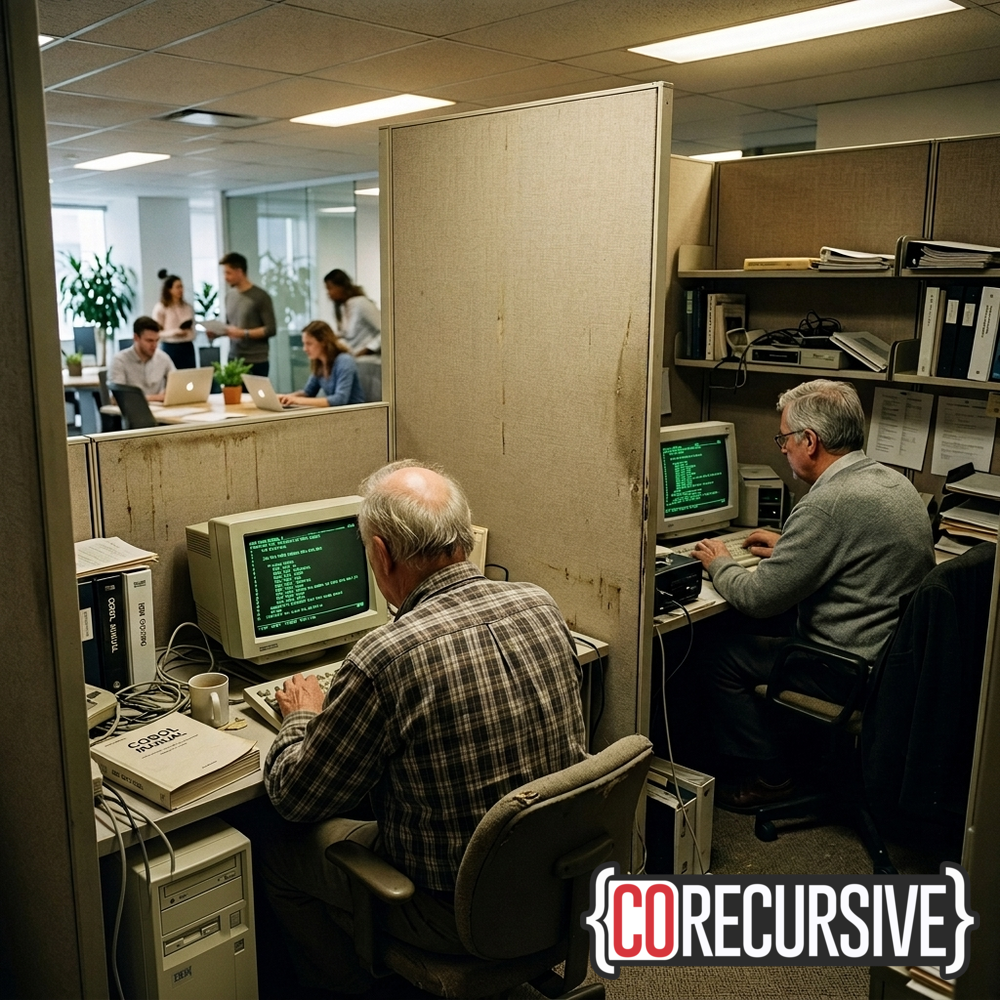
And like, that’s historically been the case in every big company I’ve ever interacted with. There’s someone in the corner. I, I, I remember one place where there were literally two people in the corner who did, and everyone set it with a little hush before this. They do the AS/400, you know, and they, and they were like behind screens.
No one else could see them. They had like dividers separating them and they were the only people in the entire building who knew the AS/400 and nobody else was gonna ever learn it either. Like they were just gonna write it down. So I guess, you know, you can think when you’re 25 and someone’s like, I don’t think this person needs to learn the new language or the new framework or the new operating system or whatever it is that we’re changing.
‘Cause someone has to maintain the old, that’s fair. But then people would say things like, I’m not sure he has the stamina for the long days this project is gonna need, and that feels a lot less fair. That’s not logic about how long a tech is gonna learn. Now you’re, you’re literally pre-judging a person based on one thing you know about them, which is what year they were born in.
And it’s like, hmm, that’s not cool.
Carry a Cane, Lose Your Voice
This kind of ages and bias doesn’t clock out when you leave the office. So Kate started collecting other stories, not just about promotions or training budgets, but about the small daily moments where somebody looks at you and decides that you are less.
Kate: People told me when I have my cane, everyone acts like I’m stupid.
People told me if they were in a restaurant with a cane, the server would ask their companion what the cane holding person wanted to order, you know? And there’s always been a certain amount of that where wait, especially in expensive restaurants, the waiter will say to the man, and for the lady, you know but.
They were saying like in any and all kinds of restaurants, got your mobility aid, not capable of ordering your own food apparently, and don’t have your mobility aid. Same person, same presentation. Now the waiters talk to you. So is that a genuine decline or loss because you had to, you know, you had to take your cane into the restaurant or is it people can suck sometimes, you know, so it can be hard to know.
Like, genuinely I can’t read that, that’s a problem. I put my glasses on to read that and you suddenly filed me under old and stopped listening to my opinion. Also a problem, but a different.
Adam: Yeah, my wife, uh, is a lawyer and she’s the same age as me, it’s such a different profession. It’s a much older profession, but like, it, it has a very clear, um, you know, people, people will continue to be lawyers forever. Like they will there. There was a guy she used to work with who was like, I want to like die in my chair, like closing a real estate deal or something. I’m not sure about that. But they have a very clear idea that, you know, you would work somewhere. There will be more senior people, uh, they may need be near the end of their careers, and then, you know, you will learn from them.
And there’s a, there’s a transfer of knowledge, there’s a, there’s a respect for the older people, but, you know, I don’t know what, why do we, we don’t have that.
Kate: No, no. Tech does not do that at all. Yeah. For employees, you know, they don’t, they don’t want, they don’t wanna see gray hair. They don’t, they don’t want to see glasses. Sure. Because, you know, nerds wear glasses, that’s fine. But then if there’s a hearing aid or a cane, or even a wrist brace, people have told me they’ve come into a meeting with a wrist brace on, which is like the number one thing that programmers do is mess up their wrists.
And there’s, there’s teasing. You know, and, and there’s like, well, he’s ready for the pasture now, and it’s like he hurt his wrist, you know?
And it’s not just attitudes. Kate found that workplaces themselves are often doing the filtering and it’s not always on purpose.
Three Flights of Stairs for a Coffee
Kate: Uh, a place I went to a couple times that had a head office where the, the CEO, who was quite young, had taken a hugely active role in designing the space. And you won’t be able to figure out who they are when I tell you, ‘cause a bunch of people in this age range have done this.
So they’re like, all the cafeterias and coffee stations and everything are all in one floor. And all the offices are in a different floor, and all the meeting rooms are in another floor. So if you want to go to a meeting, you have to go up and down some stairs. And if you want to go get a coffee, you gotta go up and down some stairs and, and it’s deliberate ‘cause we want everyone to be fit, right?
So you jump up from your desk and you run down two flights of stairs and you grab a coffee and you run up three flights of stairs and you go to your meeting and then you maybe even have to go down a flight of stairs to pee. And that’s fantastic. ‘cause now we’re all in shape and it’s like, yeah, but I’m, I’m 65 and I have a bad knee.
And, and the elevators are slow and they’re at the far end and no one is talking. Like when I was in my twenties, meetings would continue in the men’s bathroom. Like every, they’d leave the meeting and go to the bathroom and finish up the meeting. But I wasn’t in the men’s bathroom. And so if you’re taking the elevator instead of the stairs, it’s that kind of thing, right?
You’re not, you’re not getting the tail of the meeting or the meeting before the meeting or whatever. It’s like, why have you done that? Why have you not got a coffee pod on every floor? Why are there not a handful of meeting rooms on every floor? Why are we running up and down the stairs and the, the 30 something is like, what’s great exercise?
Okay, but, but it’s also an environment problem. It means I can’t function well in this environment, so that’s a genuine decline that I can’t just run up three flights of stairs and not care. But is it a body problem or is it a workspace problem?
Where the Fifty-Year-Olds Go
Kate: If you are 65 with a bad knee. You don’t last long in the place where everything’s on a different floor and you’re expected to run up and down the stairs.
So you move on, you know? And if a, if a culture, including the, the built form of the workspace supports yourself, then you stay there longer. And if it doesn’t, then you leave. And it’s, it’s even possible that there’s something going on in a workplace full of 50 year olds where the 20-year-old is like, I wanna work somewhere that has a foosball table, so they move on.
You know, places definitely have atmospheres, they have a ambiance and they have prejudices and, uh, good. And for the, for the good and for the bad. It’s also really difficult these days to get genuine like throughput, where like people are always coming in. At, you know, 20 and then they stay there till they’re 50.
They, they come in and they go. They come in and they go. So that will filter more quickly to just people who are comfortable.
Adam: Yeah, it’s weird. Over maybe a year and a half ago I was interviewing for some jobs. There was an AI place I was pretty interested in, but they were all, you know, 25 and they all worked in like a single room, in San Francisco, like I think there could have been some challenges to, to working there because I was just a different person than, uh, than they were.
Kate: You know, like some jobs if you have a kid and you wanna go home and put your kid to bed and the job is like, no, we’re all gonna work till 10 tonight. And you’re like, I’m gonna go put my kid to bed. Like. It’s just priorities are different in different parts of your life. They don’t have kids yet, so they’re fine with, with work until midnight sometimes, you know, and it’ll come around again for the parents because their kids will grow up and move out and, and then you can stay up to midnight once in a while.
You know, it’s just phases of your life and, and, and your priorities outside of work as well as your priorities at work.
The Person Who Wrote This Is Gone
Here’s what this makes me think of. People fit somewhere for a while and then they don’t, and they go. And what’s left behind is the work itself. Every code base is a record of someone’s thinking. Many people’s thinking over time, the way they solve problems, the way they cared about it, what they put off till later.
And eventually someone has to read that record and they have to make sense of it ‘cause they need to add something new. And that’s actually been a big part of Kate’s consulting work.
Kate: So you don’t always know, right? They say the person who wrote this is no longer with us. Which usually just means they work somewhere else now, but sometimes you’ll be dealing with something and is there any way, can I email them? Like, I, I just, I just need a couple quick, and they’re like, no. Oh.
Did, did they leave on bad terms? And then eventually they tell you like, no, he, he died. And after a while I would ask fairly early on in the engagement, like, do you have any access whatsoever to the old person or have they died? And I would say about a third of the time they had died. Yeah.
Adam: Oh.
Wow.
Kate: And it’s, I don’t know if it’s a particular, like a lifestyle thing that it’s dangerous to be this kind of programmer, but you know, the company was entirely dependent on one person. That was really common. Really common. I mean, obviously if it was only dependent on two or three, they wouldn’t need to bring a consultant in to rescue them. So that’s why it’s common for me to see it. But that the nobody was expecting to have to do without them. And then one day they did.
Yeah. And um, in some cases the people involved were also dealing with like the loss of a coworker in that way. So they weren’t really able to be very helpful either or, or to answer questions about how they worked or what they did. ‘cause they didn’t wanna talk about it ‘cause they missed them. That was really weird.
It’s almost better if the person is horrible and then quit and everybody hates them because then they’ll tell you stuff. They’ll tell you like, oh, he never ran the tests. Don’t be puzzled if the tests don’t pass. He always bypassed the tests. But if, but if it was a, a more tragic situation, you don’t get that honesty.
Adam: Does taking over code like that, and knowing the person has, has passed, like is, is dead, does that, does that change anything about that? Or it’s still the, the same.
Kate: It’s always freaky because especially when somebody clearly thought they could come around to something again later. And our lives are full of things we thought we could come around to again later. So when you read something and you know, maybe it’s even got like to-do comments in it or it says fix up after such and such meeting, that kind of stuff.
I mean, ‘cause that’s what I’d find. I’d find a note that would say fix up after November team meeting and I’d have to go find somebody and find out like, what was the November team meeting about? Did it happen? What was decided? How can I possibly fix this code up now that I know that, we always think we’re gonna have tomorrow.
You know, I don’t, we couldn’t function if we didn’t think we were gonna have tomorrow. And here is someone who thought they had tomorrow and did not. Yeah. Didn’t get to the November team meeting.
A Lump Under Her Chin
Kate knows about not making it to the meeting. In 2016, she found a lump under her chin, stage four metastatic melanoma. And she wasn’t expected to make it until Christmas, but she made it.
Uh, check out episode 56, Memento Mori. To hear that story, it’s, it’s amazing.
And surviving that changed how she thinks about everything else that goes wrong with you as you get older. She often talks about thing one, the big obvious problem that overshadows everything else.
Kate: So while I was sick, thing one was cancer, but not every symptom that I had was because I had terminal cancer. I still had other things happen to me. And there are people in my family who are artistic or who have A-D-H-D-I have other challenges, but again, that’s not always what the problem is.
Like you’re having trouble focusing when people talk, it turns out you’re just not hearing them properly. And, and soon you get your ears cleaned out and then you find out your pants make noise when you walk. And then a whole pile of auditory processing problems went away because they were not thing one, your ears were just messed up.
And so I had a very sore knee, my clutch knee, and I drove standard transmission all the time until I got sick. Up until the last 10 years and I spent a lot of that time driving back and forth across Toronto on Highway 401 in rush hour traffic. And that means a lot of clutch. In and out of first gear and stop and go.
And I felt that I had just worn my knee out. And one day I said to my doctor, like, oh my, my bad knee is even worse than ever. She’s like, what do you mean your bad knee? And she starts poking me and touching me and making me, you know, bend my knee and do things. And she’s like, you have injured your knee.
And I went and I had laparoscopic surgery on the knee and now I don’t have a bad knee anymore. Like my knees are the same. And I just assumed it was like, I’ve worn it out because I’m old and, and I got it fixed and I can just go up and down stairs and it doesn’t hurt and I don’t have a bad knee anymore.
And then on a routine CAT scan to make sure her cancer wasn’t back, the doctors found something else.
Kate: And that said, uh, there is a idiopathic stenosis, blah, blah, blah, blah, blah. And I’m like, that’s the thing. I don’t know. I mean, I know stenosis is a narrowing, but I don’t know what this means as a, and I looked it up and then I’m like, wait, I have those symptoms.
I did not think that that was a thing, you know, uh, which is, it’s just sometimes it feels like there’s something in your throat, but you can’t cough it out. You can’t swallow it down and you can’t get a good breath. And, and so I went, I went and I said, Hey, it says on my CAT scan that I have an idiopathic stenosis and I’m totes having the symptoms of that.
Can we fix it? And they’re like, sure. And they fixed it. I don’t recommend routine, you know, yearly CAT scans for everyone. But it was, it was really interfering with like my bike riding because it causes you, if you exert yourself, your throat starts to swell up and you can’t get a good breath. Now it doesn’t do that anymore.
The Dangerous Story You Tell Yourself
Kate’s knee wasn’t because of aging really, and her throat wasn’t cancer. These were specific problems with specific fixes, but she almost missed them both because she’d already written a story to herself about why things were getting worse, and that’s a common pattern that she kept finding.
The biggest danger isn’t what actually is breaking down. It’s the story you tell yourself about why.
Kate: If you have a bad attitude toward old age. If you think old people are stupid and incompetent and incapable and pathetic, you’re more likely to have a heart attack later.
Adam: Oh wow.
Kate: Than if you think it’s great to be old and they’re wise and we should revere them and help them. And you look forward to being old. And it’s like, what? How can that make you have a heart attack?
And it’s a, it’s a, a real result. Like they, they did, you know, long cohort things where they kept asking people how they felt about all kinds of stuff, not just aging. And then they could track these people’s health outcomes. And the, the explanations seem to be twofold. One, if you think being old is horrible, when it happens to you, you’re gonna be very stressed.
So you’re gonna be swimming in cortisol and other stress hormones and, and maybe this is why you end up having cardiovascular events. Uh, but the other ones, if you think it’s a long, slow slide to the grave, then when your knee hurts. So you can’t do that thing anymore. You just stop doing that thing. And when you think that you can be vibrant and active and still do what you used to do, you go in and you say, Hey, my knee hurts somebody fix it.
And, and boy.
The Script Everyone’s Been Raised On
Kate: Lots of people believe a lot of terrible things about older people. None of which are true, but they believe them anyway. Unfortunately, they can all be, uh, self-fulfilling prophecies. Take that waiter who won’t take the person’s order if in a restaurant, if they’re carrying a cane, but instead asks their companion for their order.
Everyone, the waiter, the companion, and even the cane carrier can all start to believe because it’s treated as so normal. Maybe I’m not capable of deciding what I wanna order in a restaurant. And if people aren’t invited to things or aren’t included in things, or aren’t sent to the conference, or aren’t sent on the course, their skills will suffer even though they might not have suffered if they had just been treated like everybody else.
So it can be very difficult to snap out of the script that you’ve been raised on, that old people are less, and the the script that everyone around you has been raised on, that old people are less. And then the reality that when you treat people as though they’re less, they do become less because they’re missing out on things.
And you will have a happier and healthier old age than you otherwise would have. And it’s more in your hands than you might think.
So Kate put all this, the survey, the research, the personal reckoning into a conference talk. She called the Aging Programmer, and she’s given it at several conferences. It’s a talk that covers eyesight and knees and how to deal with your wrist and why you should exercise and, uh, you know about loneliness, practical stuff.
It is a very important talk, but not necessarily when you’d expect to get an emotional response from.
The Talk That Made People Cry
Kate: And, a number of people have come up to me after the talk and said that it made them cry, which was not my intention, but it certainly has, has happened to a bunch of people who, who watch the talk.
Adam: Why did, why did it make them cry?
Kate: Um, because I think we get through by, by believing that we will always have tomorrow. And part of part of getting older is accepting the fact that there are losses, there are a lot of losses and that we, there are out of our control.
People I went to university with, they’re dead now. Right? You, you can look ’em up like, Hey, I should look that person up. We haven’t talked in years. Wonder what they’re doing. Oh, they’re not doing anything. Okay. Or sometimes like you get a phone call or a WhatsApp or whatever about someone else who you talk to every other year or every third year and they’re like, Hey, you, you should know that John died.
So I mean, that’s real. Lots of other things are real too. Like friends move away, friends change, relationships, change, uh, and just petty stuff like TV shows end and, and, and people stop making the cereal that you’ve had every day for breakfast and now you can’t, can’t get that cereal anymore. And that’s just, if you stay alive, the world changes around you.
There will be losses.
The Only Cure for Loss
Kate asked people in her survey when they wanted to retire and almost no one did. 20-somethings figured by 50. That sound right? The people approaching 50 strongly disagreed. They wanted to go longer. And then when she asked them what worried about it, it wasn’t just health, it was purpose, it was boredom.
Kate: But there, there is also, if you look for it, there’s also a, a widening, not necessarily in front of you, but behind you. Like I said to someone last week, you generally don’t know what you’ve dedicated your life to until you’ve dedicated your life to that.
And you look back and you go, wow, look what I’ve been doing for 40 years. Like. That must be what I’m dedicated to. But I didn’t, you know, when you’re 20 you’re not like, here’s what I’m gonna do. You’re who you are and what you’re known for. Can, can ripen, enrichen, but you have to, you have to look for it.
There will be losses and some of them will be really profound and horrible and some of them will be petty, but in some ways will be worse.
And you have to figure out how to cope with that. And, and from where I sit, I talked to a bunch of people and I read a bunch of stuff. The only cure for loss is gain.
And you have to seek that gain out. You have to go out and try to gain new friends, new favorite cereals, new favorite TV shows, new hobbies, whatever to take the place of the things that you will lose. ‘Cause you just will lose some things all the time.
For Kate, this isn’t all research. She’s 63. She’s a cancer survivor, but she still does a little consulting and she’s still giving conference talks.
So what does any of this actually look like for her?
Kate: So I definitely, we like to say we’re trying to put the semi in semi-retired. Sometimes it seems like it’s much more binary than that. Um, but yes, found a spot where I’m okay with what I can and can’t do and what I do and don’t wanna do. And they’re not always, you know, the same thing.
One of the things I say about the good parts though is like if there’s something you don’t wanna do, people just accept it from you when you’re older.
So like you can just say, oh, I don’t do evening events, and they’re like, okay, you know, that’s fine. Which I really can’t. One, one of the very few consequences I have from the immunotherapy is I do get tired much, much earlier than anyone else I know. And I may go to bed at seven, so I can’t go to your thing.
I can’t do pushups from the ground because of my wrists, but I can do inclined pushups on stairs. And if I have a week where I do sets of 10, two or three times a day by the end of the week, I’m going from a different stair.
You know, I can, I can change the angle at which I can do the pushup because my arms have gotten stronger in that small amount of time.
Adam: What’s your advice, you know, for 35-year-old, 45-year-old Kate?
Your Neighbors Want to Shovel Your Steps
Kate: You need reserves. You need resources, right? You need things you can draw on, and sometimes that’s just literally money in the bank. Sometimes it’s a good credit rating. The, a big line of credit that you could, you could borrow from. But it’s also like knowing a lot of people, having folks you can reach out to.
It’s knowing that people like helping, which was a big lesson for me when I was sick. I did not understand. People really want to help. So if you can’t shovel your steps. Maybe because you’re old or maybe because you broke your ankle, your neighbors, at least the first few times will be actively happy to shovel your steps.
Like they will go around all week going, oh yeah. And I shoveled my neighbor’s steps, by the way. Yeah, I did. Mm-hmm. I like to be helpful, like just every stereotype of an 8-year-old helping bring the groceries in. We stay like that our whole lives. So giving people a chance to help you is in small doses is a real gift to them.
These skills can apply in a variety of different contexts and you never know when they’re going to literally be life or death. So yeah, just build up, build up resources and, and build up a plan and understand that you will draw this stuff down later. You’re building it up for yourself.
Plan. I think I did okay with what I’ve accumulated. I could have done better and I could have started sooner.
Outro
That was the show. Thank you to Kate Gregory, C++ developer conference speaker, diagnoser of team problems, one of the three leads on the Carbon programming language, and someone who’s figured out how to keep going on her own terms.
The conference she built, CppNorth, which is in Toronto, has grown into NDC Toronto. Now it’s five tracks, everything from C++ to Rust to AI, and it’s May 5th through May 8th in Toronto. Go to NDCtoronto.com.
And if Kate’s putting it on, I’m sure that it is spectacular. And for me and my concerns about aging, well, the only cure for loss is gain. I’m now 45, but I’m still adding things to my list, and that is to count for something, right?
So until next time, thank you so much for listening.
Support CoRecursive
Hello,
I make CoRecursive because I love it when someone shares the details behind some project, some bug, or some incident with me.
No other podcast was telling stories quite like I wanted to hear.
Right now this is all done by just me and I love doing it, but it's also exhausting.
Recommending the show to others and contributing to this patreon are the biggest things you can do to help out.
Whatever you can do to help, I truly appreciate it!
Thanks! Adam Gordon Bell
